Workshop on “Trustworthy Data-Driven Control: From Finite Samples to Robust Guarantees” 


A co-located workshop of the IFAC World Congress 2026, Busan, Republic of Korea, August 23-28, 2026. Registration information is available here, with an early registration deadline for this workshop set for May 31, 2026.
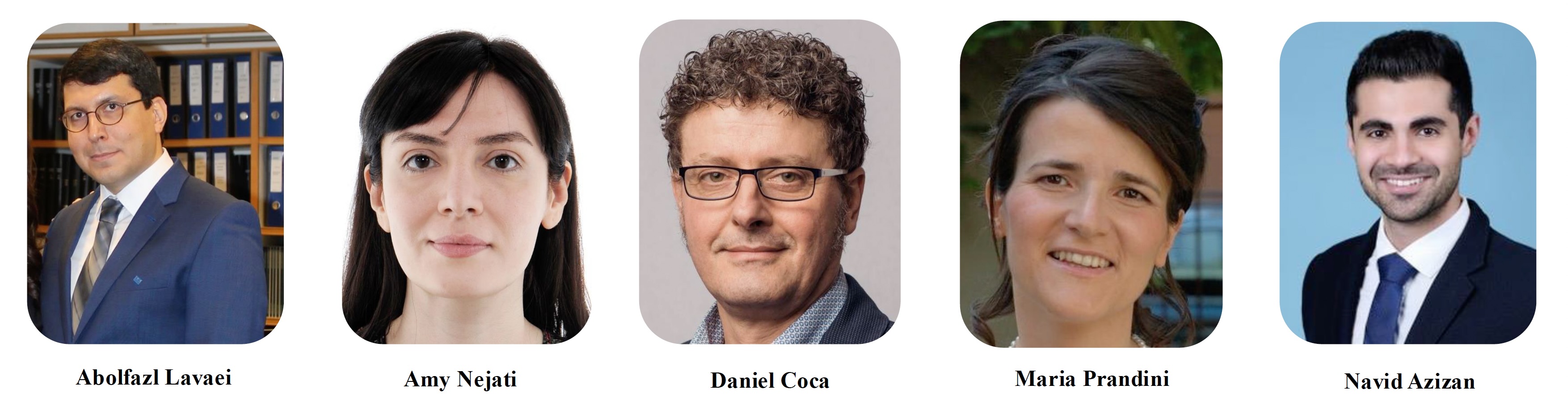
Organizers

Scope
Modern engineering systems are growing in complexity, with distributed physical systems increasingly integrated with computational elements, often operating under uncertainty. These large-scale complex systems play a vital role in many sectors, particularly those where safety is paramount. Examples span domains such as autonomous robotics, intelligent transportation networks, energy and healthcare infrastructure. Achieving high-fidelity models for such systems requires accurately capturing the dynamics and interactions of their individual components. However, the presence of noise, strong nonlinear couplings, and tight integration between components causes model complexity to grow rapidly, making accurate modeling increasingly difficult in practice. Even when such models can be constructed, their complex structure often hinder their practical use in verification and synthesis, limiting the effectiveness of traditional model-based approaches.
In the absence of accurate mathematical models, recent advances in sensing and data acquisition have enabled the collection of large volumes of system behavioral data. This growing availability of such data enables systematic analysis and the principled design of controllers, i.e., the decision-making software governing autonomous operation. As a result, there is an increasing need for data-driven methods that can operate directly on observed input–output interactions and effectively address systems with unknown or partially known dynamics.
Several data-driven techniques have been proposed for verification and controller synthesis. One may classify them in two types: the indirect and direct approaches. More specifically, indirect data-driven techniques are those which leverage system identification to learn approximate models of unknown systems, followed by model-based controller analysis approaches. Their advantage is that once the identification phase is achieved, one may rely on the powerful armada of techniques available in model-based control. In comparison, direct data-driven techniques are those that bypass the system identification phase and directly employ system measurements for the control analysis of unknown systems.
While data-driven approaches offer substantial promise, a fundamental challenge remains: analysis is inevitably based on finite data. This raises the question of how conclusions can be expected to generalize to the system’s full behavior, including scenarios not represented in the dataset. Addressing this challenge requires methodologies that provide robustness guarantees extracted directly from input–output data.
Objectives of the workshop
The main objective of this workshop is to provide a coherent and forward-looking forum for advancing data-driven control of complex systems with provable guarantees. By bringing together leading researchers working at the intersection of control theory, learning, and formal verification, the workshop aims to critically assess recent progress, highlight emerging challenges, and identify promising research directions in this rapidly evolving area. Through a carefully curated set of invited talks, the workshop seeks to equip participants with both conceptual insight and practical perspective on principled data-driven methodologies. In particular, the workshop aims to:
Offer researchers new to the area a clear and structured overview of the state of the art in data-driven control, covering both indirect and direct approaches.
Discuss scalable data-driven approaches that enable control and verification to remain computationally and statistically efficient as system dimension and data requirements increase.
Highlight emerging application domains where data-driven control with guarantees can have significant impact.
Expected outcomes
The workshop is expected to provide a consolidated and up-to-date perspective on data-driven control with provable guarantees, clarifying current capabilities, limitations, and open challenges associated with finite-data analysis. By bringing together complementary viewpoints spanning direct and indirect data-driven methods, learning-based control, and formal verification, the workshop will help identify common theoretical foundations and promising directions for scalable and robust methodologies. A key outcome will be increased awareness of principled approaches for extracting safety, stability, and performance guarantees directly from data, even in the presence of uncertainty and incomplete information. In addition, the workshop aims to foster cross-disciplinary dialogue between control theory, formal methods, and statistical learning communities, thereby strengthening connections across traditionally separated research areas. Finally, we hope that the active discussions among participants will lead to fruitful collaborations, new research initiatives, and follow-up activities that further advance trustworthy data-driven control.
Prerequisites
No specific prerequisites are required to attend the workshop. The presentations are designed to be accessible and will provide participants with exposure to fundamental concepts and recent advances in data-driven methods for the formal analysis and control of dynamical systems.
Tentative Workshop Program — August 23, 2026 (Local Time)
| 8:50 – 9:00 | Welcome and opening remarks |
| 9:00 – 9:40 | Hideaki Ishii, University of Tokyo, Japan Data-Driven Control under Imperfect and Unreliable Data (slides) |
| 9:40 – 10:20 | Alessandro Chiuso, University of Padova, Italy From Data to Control: A Journey on the Role of Models, Uncertainty and Behaviors with Bayesian Perspective |
| 10:20 – 10:40 | Coffee break |
| 10:40 – 11:20 | Miroslav Krstic, UC San Diego, USA Neural Operators That Stabilize Infinite-Dimensional Systems (slides) |
| 11:20 – 12:00 | Abolfazl Lavaei, Newcastle University, UK Data-Driven Stochastic Control with Probabilistic Guarantees (slides) |
| 12:00 – 14:00 | Lunch break |
| 14:00 – 14:40 | John Lygeros, ETH Zurich, Switzerland Optimal Control with Linear Programming: Finite Sample Guarantees (slides) |
| 14:40 – 15:20 | Mahrokh Ghoddousi Boroujeni, EPFL, Switzerland PAC-Bayesian Optimal Control with Stability and Generalization Guarantees (slides) |
| 15:20 – 15:40 | Coffee break |
| 15:40 – 16:20 | Murat Arcak, UC Berkeley, USA Scalable and Robust Safe-Set Methods for Control and Verification with Learning (slides) |
| 16:20 – 17:00 | Abraham P. Vinod, Mitsubishi Electric Research Laboratories (MERL), USA Robust Guarantees from Data: Bandits and Quantiles (slides) |
| 17:00 – 17:30 | Discussions and closing remarks |
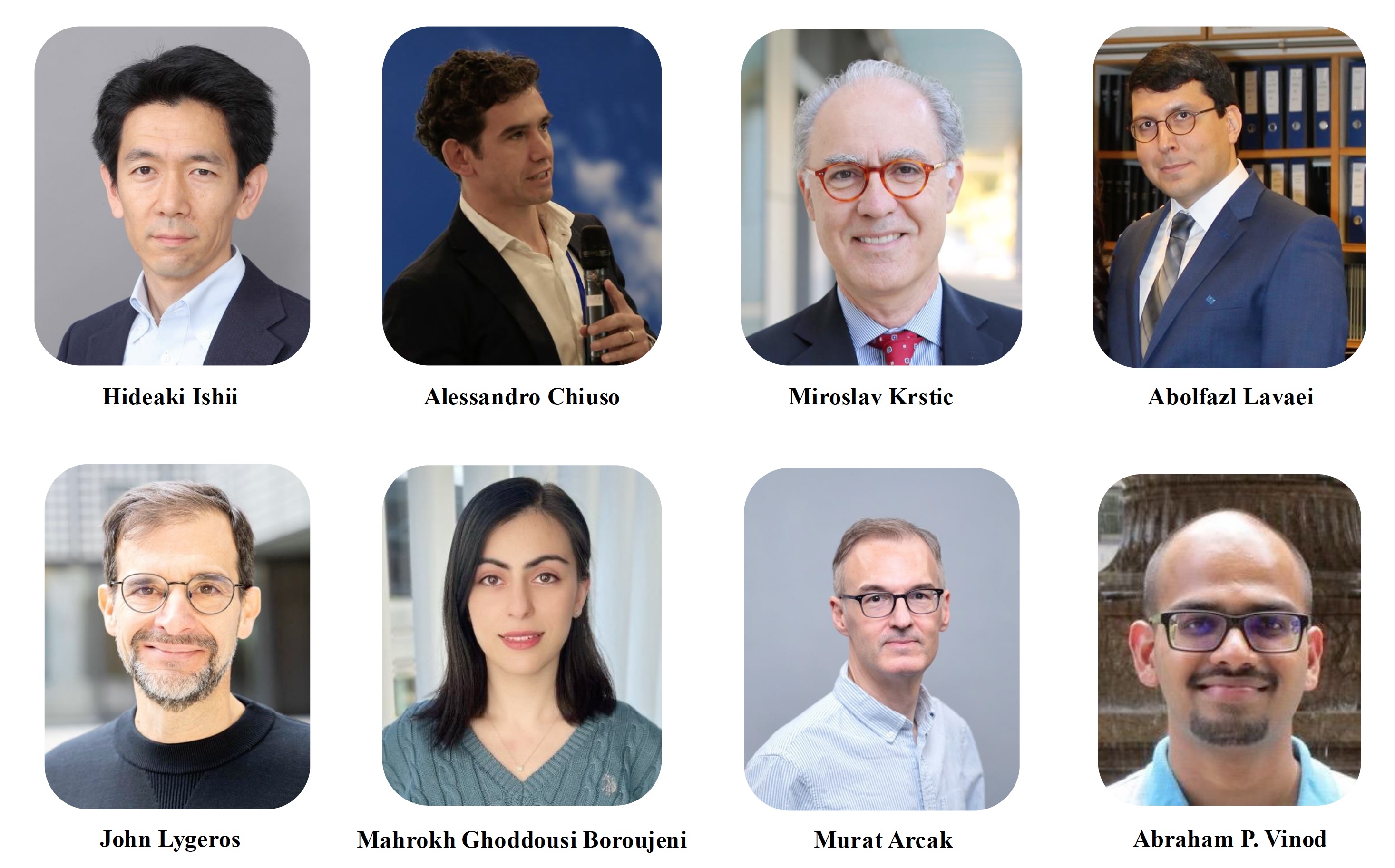
Speakers (in alphabetical order)
Speaker: Murat Arcak
Affiliation: Professor at UC Berkeley, USA
Title: Scalable and Robust Safe-Set Methods for Control and Verification with Learning
Abstract: This talk presents our recent work on scalable safe-set methods for control and verification that integrate data-driven learning with model-based analysis. First, we introduce data-driven approaches to reachability analysis that use a finite ensemble of sample trajectories to estimate reachable sets with probabilistic accuracy guarantees. Second, we describe methods that combine learning and physics-based modeling through Gaussian process representations, enabling the integration of data-driven flexibility with the structure and insight of model-based approaches.
Biography: Murat Arcak is a Professor of Electrical Engineering at the University of California, Berkeley. His research is in control theory, autonomous systems, and multi-agent systems, with applications in transportation, energy, and biology. He received a CAREER Award from the National Science Foundation in 2003, the Donald P. Eckman Award from the American Automatic Control Council in 2006, the Control and Systems Theory Prize from the Society for Industrial and Applied Mathematics (SIAM) in 2007, and the Antonio Ruberti Young Researcher Prize from the IEEE Control Systems Society in 2014. He is a member of SIAM and a fellow of IEEE and International Federation of Automatic Control (IFAC).
Speaker: Alessandro Chiuso
Affiliation: Professor at University of Padova, Italy
Title: From Data to Control: A Journey on the Role of Models, Uncertainty and Behaviors with Bayesian Perspective
Abstract: In this talk I shall discuss, from a Bayesian l perspective, some recent developments in data-driven control, discussing the role that models have, how uncertainty can be exploited to robustify the control design problem, and how this fits in the stochastic behavioral framework. Extensions to non-linear and adaptive control will be discussed.
Biography: Alessandro Chiuso (Fellow, IEEE) is Professor with the Department of Information Engineering, Università di Padova. He received the “Laurea” degree summa cum laude in Telecommunication Engineering from the University of Padova in July 1996 and the Ph.D. degree (Dottorato di ricerca) in System Engineering from the University of Bologna in 2000. He has been a visiting scholar with the Dept. of Electrical Engineering, Washington University St. Louis and Post-Doctoral fellow with the Dept. Mathematics, Royal Institute of Technology, Sweden. He joined the University of Padova as an Assistant Professor in 2001, Associate Professor in 2006 and then Full Professor since 2017. He has served as an Associate Editor for Automatica, IEEE Transactions on Automatic Control, IEEE Transactions on Control Systems Technology, European Journal of Control and MCSS. He is currently serving as senior editor (System Identification and Filtering) for Automatica and chair of the IFAC Coordinating Committee on Signals and Systems. He has been General Chair of the IFAC Symposium on System Identification, 2021 and he is a Fellow of IEEE (Class 2022). His research interests are mainly at the intersection of Machine Learning, System Identification and Control.
Speaker: Mahrokh Ghoddousi Boroujeni
Affiliation: Postdoctoral Researcher at École Polytechnique Fédérale de Lausanne (EPFL), Switzerland
Title: PAC-Bayesian Optimal Control with Stability and Generalization Guarantees
Abstract: Stochastic Nonlinear Optimal Control (SNOC) minimizes a cost function that accounts for random disturbances acting on a nonlinear dynamical system. Since the expectation over all disturbances is generally intractable, a common workaround is to optimize an empirical objective formed by averaging over a finite set of disturbance realizations. This substitution can be brittle: learned controllers may overfit, yielding a large generalization gap between empirical performance and performance under unseen disturbances. In this talk, I present a PAC-Bayesian framework that delivers finite-sample generalization bounds for SNOC. I then show how these bounds lead to a scalable approach for synthesizing neural network-based controllers that targets performance under unseen disturbances, rather than the empirical objective alone. Finally, I discuss how to incorporate informative priors and guarantee closed-loop stability. The framework provides a practical method for designing neural controllers with explicit generalization and stability guarantees.
Biography: Mahrokh Ghoddousi Boroujeni received her Ph.D. from École Polytechnique Fédérale de Lausanne (EPFL), Switzerland, in 2025. She received her B.Sc. in Electrical Engineering and Computer Science from Sharif University of Technology, Tehran, Iran, in 2020. Her research interests include learning-based control, stability and generalization guarantees, probabilistic modeling, and meta-learning.
Speaker: Hideaki Ishii
Affiliation: Professor at the University of Tokyo, Japan
Title: Data-Driven Control under Imperfect and Unreliable Data
Abstract: Data-driven approaches to control enable analysis and controller design directly from measured data, without requiring explicit identification of a mathematical model. At the same time, their success relies critically on the quality and reliability of the available data. In practical systems, data may be affected by limited precision in sensing and communication, or may even be intentionally manipulated by malicious agents. In this talk, we discuss recent results on data-driven control and analysis in the presence of such imperfect and unreliable data. We first consider quantization in data-driven controller design, where both the data used for controller synthesis and the signals available during feedback control are subject to finite precision. We highlight the resulting trade-off between quantization requirements at the design and implementation stages. We then turn to data poisoning attacks and investigate how malicious modification of measured data can affect data-driven analysis of system properties, with a particular focus on observability. We present conditions under which such attacks can alter conclusions drawn directly from data and discuss their implications for reliable data-driven control. These results illustrate the importance of accounting for data quality and integrity when extending data-driven methods to practical and potentially adversarial environments.
Biography: Hideaki Ishii received the M.Eng. degree from Kyoto University in 1998, and the Ph.D. degree from the University of Toronto in 2002. He was a Postdoctoral Research Associate at the University of Illinois at Urbana-Champaign in 2001-2004, and a Research Associate at The University of Tokyo in 2004-2007. He was an Associate Professor and then a Professor at the Tokyo Institute of Technology, Yokohama, Japan, in 2007-2024. Currently, he is a Professor at the Department of Information Physics and Computing, The University of Tokyo since 2024. He was a Humboldt Research Fellow at the University of Stuttgart in 2014-2015. His research interests include networked control systems, multi-agent systems, distributed algorithms, and cyber-security of control systems. Dr. Ishii has served as an Associate Editor for journals including Automatica, the IEEE Transactions on Automatic Control, and the IEEE Transactions on Control of Network Systems. He was a Vice President for the IEEE Control Systems Society (CSS) in 2022-2023 and the Chair of the IFAC Coordinating Committee on Systems and Signals in 2017-2023. He served as the IPC Chair for the IFAC World Congress 2023 held in Yokohama, Japan. He received the IEEE Control Systems Magazine Outstanding Paper Award in 2015. Dr. Ishii is a Fellow of IEEE and IFAC.
Speaker: Miroslav Krstic
Affiliation: Distinguished Professor at UC San Diego, USA
Title: Neural Operators That Stabilize Infinite-Dimensional Systems
Abstract: Machine learning and AI expand capabilities but typically without offering guarantees. Neural operators (NOs) - approximators of nonlinear mappings of functions into functions - have grown popular in physics for rapid solving of the underlying PDE models. This talk shows how universal approximation theory for NOs, feedback design for PDEs and nonlinear ODEs with delays, and constructions of Lyapunov functionals for such infinite-dimensional systems are combined to produce stability guarantees in spite of relying on machine learning. NOs speed up control computation thousandfold and make control of PDEs and nonlinear delay systems practically feasible. Examples will be provided from traffic control and stabilization of nonholonomic robots with delays.
Biography: Miroslav Krstic is Distinguished Professor at UC San Diego and Editor-in-Chief of IEEE Transactions on Automatic Control. He has received the IEEE Brockett Control Systems (Field) Award, Bellman Award, Bode Lecture Prize, SIAM Reid Prize, ASME Oldenburger Medal, ASME Nyquist Lecture Prize and Paynter Award, Ragazzini Education Award, and several IFAC awards (Chestnut Textbook Prize, Nonlinear Control Systems Award, Ruth Curtain Distributed Parameter Systems Award, Adaptive and Learning Systems Award, Time-Delay Lifetime Achievement Award). Krstic is Fellow of IEEE, AIAA, IFAC, ASME, SIAM, AAAS, IET, and Serbian Academy of Sciences and Arts. Krstic has coauthored nineteen books and his industrial transitions have been in chip photolithography and advanced arresting gear on carriers.
Speaker: Abolfazl Lavaei
Affiliation: Assistant Professor at Newcastle University, UK
Title: Data-Driven Stochastic Control with Probabilistic Guarantees
Abstract: In this talk, I will discuss the development of data-driven methods for stochastic control systems that provide probabilistic safety guarantees directly from trajectory data. Unlike traditional worst-case robust approaches that assume bounded disturbances and often lead to overly conservative designs, the proposed framework models uncertainty through stochastic process noise with unknown distributions. By leveraging trajectory-based data collected under multiple realizations and constructing stochastic control barrier certificates, the approach yields certified confidence levels on safety over finite horizons, offering a less conservative and more practical alternative for real-world systems.
Biography: Abolfazl Lavaei is an Assistant Professor in the School of Computing at Newcastle University, United Kingdom. Between January 2021 and July 2022, he was a Postdoctoral Associate in the Institute for Dynamic Systems and Control at ETH Zurich, Switzerland. He was also a Postdoctoral Researcher in the Department of Computer Science at LMU Munich, Germany, between November 2019 and January 2021. He received the Ph.D. degree in Electrical Engineering from the Technical University of Munich (TUM), Germany, in 2019. He obtained the M.Sc. degree in Aerospace Engineering with specialization in Flight Dynamics and Control from the University of Tehran (UT), Iran, in 2014. He is the recipient of several international awards in the acknowledgment of his work including Best Repeatability Prize (Finalist) at the ACM HSCC 2025, IFAC ADHS 2024, and IFAC ADHS 2021, HSCC Best Demo/Poster Awards 2022 and 2020, and IFAC Young Author Award Finalist 2019.
Speaker: John Lygeros
Affiliation: Professor at ETH Zurich, Switzerland
Title: Optimal Control with Linear Programming: Finite Sample Guarantees
Abstract: Casting an infinite-horizon, nonlinear optimal control problem in continuous state-action spaces as an infinite dimensional linear program (LP) is an elegant approach that comes with many advantages. One of them is the possibility of using data sampled for the system to generate finite dimensional approximations of the LP whose quality improves as the amount of data increases. Implementing this approach computationally, however, is far from straightforward, a fact that has arguably prevented the LP method from becoming as popular as policy iteration- and value iteration-based approximations. Besides the curse of dimensionality, additional difficulties such as obtaining bounded solutions consistently, boot-strapping small amounts of data to generate additional samples, etc. need to be addressed. Here, we first introduce the general LP method for approximate dynamic programming, then discuss conditions on the system and the data under which such computational difficulties can be addressed.
Biography: John Lygeros completed a B.Eng. degree in electrical engineering in 1990 and an M.Sc. degree in Systems Control in 1991, both at Imperial College of Science Technology and Medicine, London, U.K.. In 1996 he obtained a Ph.D. degree from the Electrical Engineering and Computer Sciences Department, University of California, Berkeley. During the period 1996-2000 he held a series of research appointments at the National Automated Highway Systems Consortium, Berkeley, the Laboratory for Computer Science, M.I.T., and the Electrical Engineering and Computer Sciences Department at U.C. Berkeley. Between 2000 and 2003 he was a University Lecturer at the Department of Engineering, University of Cambridge, U.K., and a Fellow of Churchill College. Between 2003 and 2006 he was an Assistant Professor at the Department of Electrical and Computer Engineering, University of Patras, Greece. In July 2006 he joined the Automatic Control Laboratory at ETH Zurich, first as an Associate Professor, and since January 2010 as a Full Professor. Between 2015 and 2018 he served as the Head of the Department of Information Technology and Electrical Engineering; since 2009 he is serving as the Head of the Automatic Control Laboratory. His research interests include modelling, analysis, and control of hierarchical, hybrid, and stochastic systems, with applications to biochemical networks, transportation systems, energy systems, and industrial processes. John Lygeros is a Fellow of the IEEE, and a member of the IET and the Technical Chamber of Greece; between 2013 and 2023 he served as the Vice President for Finances and a Council Member of the International Federation of Automatic Control (IFAC), as well as the Board of the IFAC Foundation. Since 2020 he serves as the Director of the National Centre of Competence in Research “Dependable Ubiquitous Automation” (NCCR Automation).
Speaker: Abraham P. Vinod
Affiliation: Principal Research Scientist at Mitsubishi Electric Research Laboratories (MERL), USA
Title: Robust Guarantees from Data: Bandits and Quantiles
Abstract: This talk presents two finite-sample pathways for turning data into robust guarantees in data-driven control. First, I will describe a multi-armed bandit framework that adaptively prioritizes regions for autonomous monitoring with constrained mobile robots, providing search-efficiency and task-completion guarantees despite noisy measurements and operational constraints. I will also highlight recent extensions to spatio-temporal monitoring. Second, I will present a sample-quantile formulation for nonconvex stochastic control that delivers finite-sample feasibility and bounded-suboptimality guarantees with favorable computational scaling. I will also present simulation and hardware demonstrations of both approaches.
Biography: Abraham P. Vinod is a Principal Research Scientist at Mitsubishi Electric Research Laboratories (MERL), Cambridge, MA, USA. His main research interests are in the areas of constrained control, robotics, and learning. Prior to joining MERL in 2020, he held a postdoctoral position at the University of Texas at Austin. He received his B.Tech. and M.Tech. degrees from the Indian Institute of Technology-Madras (IIT-M), India, and his Ph.D. degree from the University of New Mexico, USA, all in electrical engineering. He was the recipient of the Best Student Paper Award at the 2017 ACM Hybrid Systems: Computation and Control Conference, Finalist for the Best Paper Award in the 2018 ACM Hybrid Systems: Computation and Control Conference, and the best undergraduate student research project award at IIT-M. He is the primary developer of pycvxset, a set computation toolbox in python, and co-developed SReachTools, a stochastic reachability toolbox in MATLAB.